Feb 17 2009

Community Orientations Podcast with Shawn Callahan

Published by under General

Our friend Shawn Callahan has been following the work on the book – for years! He has been privy to various drafts and has recently been using the Community Orientations in his work with communities.

Recently he realized he wasn’t so clear on orientations 7, 8 and 9 so this past weekend we hooked up on Skype and talked through them. Here is Shawn’s post and the podcast.

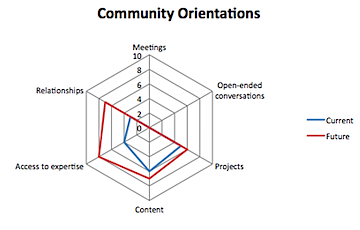
As we talked, I was interested to hear about the exercise he did with the orientations, and see how it compared to how I’ve been using them. Here is what Shawn wrote:

BTW the community orientation exercise simply involved getting the participants of the workshop to plot on a radar chart, which I’d drawn on a whiteboard, where they thought the community was currently and then do this again for where they would like to see the community of 12 months time. It generated a terrific conversation and a feel of mutual purpose. Here is what the result looked like.

I had not thought about using the orientations for community plans or aspirations. I had been using them as a diagnostic for technology stewards to a) become aware of key community orientations and b) then use that to plan or tweak the community’s technology configuration. But both make a lot of sense to me!

Thanks, Shawn

Nancy

2 responses so far

Feb 03 2009

Ward Cunningham interviews John Smith

Published by under General,History

Ward Cunningham just recently set up his own channel on YouTube and has edited a conversation we had last Fall. His philosophy for conducting interviews is simple and effective: make guests feel comfortable and ask them questions that make them look good. He did a great job making me feel comfortable.

We start by talking about how, in writing the book, we tried to not “just” be experts, but to also get at our experience and the more intimate level at which communities live. At the very end I remember to tell him that his interaction with the community that formed on his wiki was one of the first instances where I glimpsed what the role of a technology steward might be about. It has taken a lot of work to write about “less technical” people might take on the role, but I’m convinced that you don’t have to be a Ward Cunningham to serve your community with respect to its technology needs.

No responses yet

Feb 02 2009

Digital Habitats Readers Guide

Readers Toolkit - cc Flickr image from  wenxinAs we wend our way down the path to final publication of the book, friends have asked us to share some of the bits and pieces that we have been using in our work and workshops. One of those is the Reader’s Guide and Action Notebook. This is now chapter 10 in the book and it provides a set of checklists to guide a technology stewards through some of the central tasks of community technology stewardship. We are making the document available here on the website both as a contribution to tech stewards everywhere, and to make it easy for book readers to download a copy to work on without writing all over their books. I like to write in my books, but I know not everyone does. 

If you use the Notebook, leave a note here with how it does or does not work for you.  We realize some of the material may not make sense without the context of the book.  But we also know it can always be improved. So your comment may contribute towards future iterations!


Flickr CC Image Credit:  wenxin

No responses yet

Dec 05 2008

Last minute revisions

January 1st, 2009 has been the target publication date for the book for a while, but that now seems to be slipping.  We’re working as hard as we can on type faces and layout details and all of that.  At the same time we’re using chapters of the book in a CPsquare workshop called “Connected Futures.”  The discussion with workshop participants last Monday convinced us that the separate and occasional problems we’ve had talking about the polarities in this slide really needed to be addressed:

So Chapter 5 is getting a quick rewrite to talk more carefully about the togetherness / separation and reification / participation polarities.  We hope the rewrite won’t affect the final publication date, but it’s an example of the complications and risks on the way to press.

Coincidentally, I’m reading a thesis from CPsquare’s research and dissertation fest titled “A system that Works for Me – an anthropological analysis of computer hackers’ shared use and development of the Ubuntu Linux system” by Andreas Lloyd.  He gives a precise and insightful observations of how a community of practice deals with the polarities through their technologies and their relationships at the same time. Referencing the thesis or discussing it is out of scope because that would delay publication!  But Lloyd’s work is a good reminder that seeking to be precise about the polarities in Chapter 5 is really worth the risk of taking extra time. The following extended quote starts on page 55:


The Jargon File describes how the importance of not being interrupted is deeply engrained in hacker etiquette:

    … if someone appears at your door, it is perfectly okay to hold up a hand (without turning one’s eyes away from the screen) to avoid being interrupted. One may read, type, and interact with the computer for quite some time before further acknowledging the other’s presence (of course, he or she is reciprocally free to leave without a word). The understanding is that you might be in hack mode with a lot of delicate state in your head, and you dare not swap that context out until you have reached a good point to pause.

I experienced this several times in my visits and interviews with Ubuntu hackers, whose partners and friends over time have come to allow room for and be forgiving of these programming­ related eccentricities. In turn, the hackers themselves often take care to balance their time on the computer in relation to their family’s needs, when they reach one of those “good points to pause.” I have found that this duality is also very characteristic for the way that hackers interact with each other on­line where you can’t assume that people are communicative at any given moment. As Ellen Ullman points out, this inability to be interrupted makes hackers somewhat asynchronous to one another – at least in the short term (Ullman 1995:132). This is reflected clearly by the fact that all of the Ubuntu hackers’ preferred on­line communicative means are textual and thus – at least to some extent – asynchronous. Email, newsgroups and web forums postings and bug tracker comments are all based on users reading and replying asynchronously. Even real time communications such as IRC chat channels and Instant Messaging bend to this rule as developers “ping” each other, and if there’s no immediate response, they can ask their question and let the other answer when he has time or attention to spare:

    09:00 carlos pitti: ping
    […]
    09:07 pitti carlos: pong
    09:08 carlos pitti: I did a mistake yesterday night and latest Edgy export has the plural form bug (bug #2322)
    09:08 Ubugtu Malone bug 2322 in rosetta “Truncated plural forms” [Critical,In progress] http://launchpad.net/bugs/2322
    09:09 carlos pitti: I’m exporting a new version with that fixed, but it would take around 23 hours
    09:09 carlos am I late to have it in the prerelease version?
    09:09 pitti carlos: ah, then I’ll rebuild the edgy packs this afternoon
    09:09 pitti carlos: it won’t go into RC anyway
    09:09 carlos ok
    09:09 pitti carlos:
    the plan is to upload the final packs tomorrow
    09:10 pitti carlos: thus I’d like to have today’s in perfect shape
    09:10 carlos I see
    09:10 carlos ok
    09:10 carlos pitti: I will ping you when the new version is available

Here, Carlos needs to notify Pitti of a new bug which he needs to take into consideration when building a group of packages for upload. Since Pitti is busy, the conversation doesn’t continue until Pitti is able to respond and they can coordinate their work. Most of the Ubuntu hackers’ day-to-day interaction takes place on IRC where they can pick up on interesting discussions and be available if someone needs to ask a question. The hackers deftly navigate back and forth between conversations, fluidly participating as the IRC client automatically notifies them when someone “pings” them or even just mentions their online moniker. And even if they miss something, they can always go back to check the chat logs or mail archives as all interactions within the community are recorded and publically archived online. At times, IRC is such an easy and non-intrusive way of quick communication that it supersedes conversation even when developers are in the same room. Mark Shuttleworth enjoys relating the story of how he went out to buy beer during one of the first gatherings of the core Ubuntu developers at his London flat. When he came back he found 18 hackers sitting in his living room, working in silence, exchanging textual information on IRC. [20] This anecdote illustrates how the work environment provided by the system takes precedence over face-to-face discussions simply to avoid breaking the flow state afforded by the computer. [21]


[20] I saw the same trend again and again at conferences, one time even witnessing two hackers quietly sitting in opposite ends of a conference room, having a furious argument on IRC about who should be responsible for fixing a troublesome piece of software, and it didn’t end until one of them looked up and saw the other hacker sitting at the far end of room and contentiously shouted: “Stop being such an arsehole!”

[21] This asynchronous sociality is not only a norm well suited to hackers’ mode of collaboration, but it is at times also a necessity as the Ubuntu hackers are spread across the multiple time zones, mostly in North America, Europe and Australia, making exchanges such as this common:

    15:56 mdz good evening
    15:57 zul afternoon
    15:58 ajmitch morning
    15:58 mdz good UTEvening

It is easy to forget that the Ubuntu community spans the entire globe, since it mostly becomes an issue when it comes to finding IRC meeting hours that fit all members of the community, and meetings typically rotate between being early morning, late afternoon, or late evening to accommodate as many time zones as possible.

No responses yet

Aug 05 2008

Four and a half years

Published by under General

Funny how you don’t update mental statistics like, “how long have you been working on the book?”  I’ve been answering the question with “three years” for a long time.  But actually we started working on the project in January 2003, so that makes it four and a half years.

During our meeting yesterday afternoon I was struck by how different the three of us are in our preferences and tastes when it comes to things like fonts, graphic images, and book design.  When you consider how we came to agreement on so many things when it comes to the content of our book, all those differences make me really appreciate the agreements that we forged during those four and a half years of collaboration

We’re working on a book title.  So the end of the project is nigh!

No responses yet

Apr 18 2008

Connected Futures workshop

We’re wrapping up our plans and materials for our new workshop, developed and presented by Beth Kanter, Beverly Trayner, Bronwyn Stuckey, Etienne Wenger, John D. Smith, Nancy White, Nick Noakes, Shawn Callahan, Shirley Williams, and Susanne Nyrop.It includes a lot of modeling of learning interactions, stratagems, and tactics using a dozen different social technologies.

We’re designing the workshop to support:

  • Getting to know each other, each other’s communities
  • Creating “a workshop as laboratory”
  • Exploring real communities, from an insider’s perspective to see community orientations & technology integration
  • Considering the role and activity of the technology stewards in authentic situations
  • Exploring the uses of social technologies to stay in touch as well as for sustained inquiry
  • Experiencing the design of learning agendas and then configuring technology to pursue those agendas
  • Articulate strategies to introduce new social technologies to a community
Readings from Wenger, White and Smith’s “Technology Stewardship for Communities” and several other sources on topics such as:
  • Communities of practice theory glimpse
  • Community technology stewardship
  • Tools and their Integration
  • Scanning the Technology Landscape
  • Orientations: community experience and configuration of tools
  • A More Distributed Future
  • A Learning Agenda

Connected futures workshop starts April 28: http://www.cpsquare.org/edu/CP2W2/

It will be a great way to test our thinking and our writing with a bunch of practitioners from all over the world!

No responses yet

Feb 29 2008

Technology classification schemes live on

I ran across this slide in a larger deck used by a colleague to deal with a set of technology decisions for the communities of practice in her company:

Apart from the way that Etienne’s classification scheme has been modified slightly to be relevant to the issues on the table, the fact that they’ve gone to the trouble of updating the diagram is a good reminder of how difficult it is to think systematically about all the tools that are out there and how they might work in practice.

No responses yet

Jan 14 2008

Blog Problems and Apologies

Published by under General

Don’t you love technical problems? Our WordPress installation had some sort of major foo and we lost everything. Even the back up was full of garbage.

Thankfully not all is lost. There is the Internet Wayback Machine where we have been able to find most of the posts. We’ll have to reconstruct some of the latter ones where we only have snippets via technorati. We’ll be adding these posts back in as time allows. If there is something in particular you need, let us know and we’ll hunt it up.

But there is one HUGE loss.

We lost all your comments. We love you. We love your comments. So we deeply apologize for their loss! We have some back up plans to avoid this in the future.

Live and learn, eh?

One response so far

Oct 09 2007

Shop-talk 24 hours a day

Published by under General

Ruby on Rails is a new and increasingly popular web application framework. Like many technologies today, it has an active community of developers and they have the customary suite of wikis, file repositories, email lists, blogs and RSS feeds. One thing that catches my eye about the Ruby on Rails community is its very active, open-ended, ongoing conversation on an IRC channel. Its shop-talk goes 24 hours a day. Last April, I captured about 12 hours of conversation overnight (Pacific time).

No responses yet

Dec 15 2006

Definition of Community Technology Steward

Published by under General

Last week I posted a bit about technology stewardship, particularly community tech stewardship. Beth asked for a definition – a great question. So John Smith, Etienne Wenger and I batted one about for a bit. Here is what we came up with.

Technology stewards are people with enough experience of the workings of a community to understand its technology needs, and enough experience with technology to take leadership in addressing those needs.

No responses yet

« Prev - Next »